


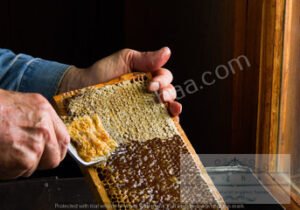
Uncapping Frame To Extract Honey
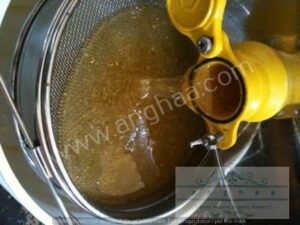
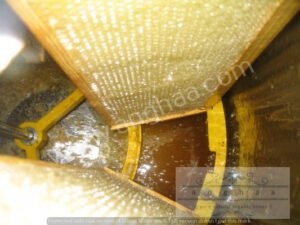
Harvesting honey involves various methods, each with its advantages. Regardless of the method, maintaining cleanliness is crucial. Ensure the workspace is clean, your hands and fingernails are washed, and hair is tied back. Avoid smoking or chewing betel nut during the process to keep the honey free from contaminants. Honey is a precious food and must be handled with care.
Honey bees store honey in beeswax honeycombs within framed beehives. The honey is stored in wooden structures called frames. When a frame is completely filled, the bees cap the cells with wax for storage. Each cell containing honey is sealed with a beeswax capping.
Harvesting Honey
To harvest honey, it’s essential to do so before the bees consume it for colony development. However, sufficient quantities must be left to meet the basic needs of the colony. The best time to extract honey is on a sunny morning when the bees are active. Approach the hive quietly and calmly, using plenty of cool smoke to ward off lingering bees.
Remove the frames one at a time and inspect them. Ensure that at least ¾ of the honey cells are sealed with wax and that there is no brood on the frame. Taking worker brood from your hive reduces your future honey makers.
Beekeepers typically harvest “surplus” honey that the bees won’t need to survive the winter or periods without abundant flowers. At Anghaa, we follow sustainable practices by removing surplus honey in late summer or early autumn, ensuring the bees have enough stored honey for the colder months.
Extracting Honey
Honey extraction is a thorough process aimed at obtaining pure liquid honey. The first step is breaking or removing the wax cappings using a slightly heated uncapping knife. Once uncapped, the frames are placed in a honey extractor, which spins them to remove the honey through centrifugal force. Care must be taken to load the frames correctly, as the comb is angled slightly upwards to prevent honey from flowing out.
After extraction, the honey contains bits of wax and must be passed through a screen to yield clean liquid honey. At Anghaa, we double strain our honey to ensure all wax is removed and purity is maintained.
Any unharvested honey left on the frames after extraction is typically returned to the colonies for the bees to clean and sterilize, preparing them for more honey. Some beekeepers place emptied frames outside for bees to reclaim, but this must be done carefully to avoid spreading disease or causing aggressive behavior among bees from different colonies.
Processing Honey
The processing of honey includes controlled heating to destroy yeast and dissolve dextrose crystals, combined with fine straining or pressure filtration. Honey can crystallize over time, which can be delayed by storing it below 10°C. Typically, honey is warmed to 32-40°C to lower its viscosity, facilitating extraction, straining, or filtration. This temperature, similar to that in beehives, does not significantly affect the honey during the short processing period. However, some honeys are heated to higher temperatures for liquefaction or pasteurization.
Containers and processing equipment should be made of materials compatible with honey’s acidity. Avoid using copper, iron, steel, or zinc, as these can dissolve into the honey and affect its color and flavor. Stainless steel, glass, and food-grade plastic are recommended. Used containers should be free of odors since honey absorbs them quickly.
Keeping Honey Clean
Maintaining honey cleanliness during extraction, packaging, and storage is vital. The next step after extraction is removing impurities such as wax particles, debris, and air bubbles. There are two practical techniques: settling and straining. Settling involves leaving the honey in a large container so impurities can separate by their specific weight. Air bubbles, wax particles, insect pieces, and other organic debris float to the surface, while mineral and metallic particles settle at the bottom. The surface scum can be carefully removed, or honey can be drawn off near the bottom for bottling.
Most retail honey is pasteurized, heated to 70°C or more, and rapidly cooled. This process makes honey look cleaner and slows crystallization but can destroy yeast and enzymes that activate nutrients in the body, affecting the honey’s aroma.
At temperatures of 25-30°C, settling is generally quick and can be completed in a few days. Tanks should be well covered to avoid excessive contact with air. The process can be accelerated by letting honey flow through buffer tanks with a water jacket, heating it slightly before flowing up and down through compartments, where impurities remain at the surface.
The Unique Characteristics of Honey
Honey’s distinctive characteristics come from its minor components originating from nectar and bees, rather than stable major compounds found in other sweet products. These substances give honey its specific aroma, flavor, and some biological activities, but they are unstable and can be destroyed by heat.
If you want to learn more about our honey processing methods, please write to us, or better yet, arrange a visit during our honey processing! It’s an exciting and informative experience. We are located near Nanital Uttarakhand. Will need 15 days to a month for arranging and facilitating.
